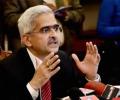
Seeking to dispel possible notions of the RBI not having done enough by opting for a pause for the second consecutive time, Das said the RBI has a wide dashboard of instruments beyond rates that can be deployed.

This demand comes at a time when the government is falling short of its revenue targets due to dwindling tax and low disinvestment receipts. It could account for the dividend in the upcoming Union Budget on February 1. RBI is, however, yet to take a final call on the government's demand and might decide on this at its central board meeting scheduled for February 15 in New Delhi.

Ashok Vaswani, a banker with more than three-and-half decades experience in building and scaling up businesses across consumer and corporate banking and payments, will be the next managing director (MD) and chief executive officer (CEO) of Kotak Mahindra Bank. Last week, the Reserve Bank of India (RBI) had given its approval to Vaswani's appointment. Vaswani is currently President of Pagaya Technologies, a US-Israeli artificial intelligence (AI) fintech firm, which he joined in June 2022.

'If there is an RBI majority in the committee, there is no question of a veto.'

Kotak Mahindra Bank was the biggest loser in the Sensex pack, sliding 2.68 per cent, followed by Tech Mahindra, Mahindra & Mahindra, Axis Bank, Hindustan Unilever, Tata Motors, Tata Consultancy Services, Bajaj Finserv, Bajaj Finance, Nestle and Titan. In contrast, NTPC, Power Grid, Larsen & Toubro, HDFC, Reliance and HDFC Bank were the gainers.

The paper seems to be suggesting strongly that the tight target range be maintained even as the central bank is all set to miss the target range for three consecutive quarters because of the Covid crisis.
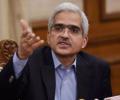
RBI Governor Shaktikanta Das said the central bank saw economic growth slowdown in February, prompting it to cut rates ahead of the curve and wondered why markets were surprised with the decision to pause rate reduction. Noting that there is a need for an "informed and objective discussion" on the country's economy, Das said the RBI would do "whatever is necessary" to address growth slowdown, spikes in inflation as well to ensure good health of banks and non-bank lenders. The apex bank went for five consecutive rate cuts starting in February this year, making it a cumulative reduction of 1.35 per cent.

The MPC states that the 4 external members will have a tenure of four years each.

No government in the past initiated the process of policy making for its next tenure even before going in for elections. Once the Model Code of Conduct is enforced by the Election Commission, should the government of the day refrain from taking an active interest in policy making for the next five years and let that be the function of the new government?, asks A K Bhattacharya.
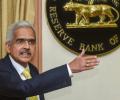
In the second policy review under Governor Shaktikanta Das, the six-member Monetary Policy Committee voted 4:2 in favour of the rate cut.

The Reserve Bank on Friday projected retail inflation to be in 5-5.2 per cent range during the first half of the next fiscal year, expecting further softening of vegetables prices in near term. Also, it has lowered the retail inflation forecast for the current January-March quarter of 2020-21 fiscal at 5.2 per cent. The Reserve Bank (RBI) has kept the key policy rate unchanged at 4 per cent, with an accommodative stance, so as to ensure that inflation remains well within the target, Governor Shaktikanta Das said while announcing the last monetary policy of 2020-21.
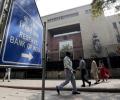
However, RBI would continue to nudge banks to cut lending rates
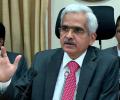
To a specific question on the change in RBI's stance from "neutral" to "accommodative", Das said it means that there will not be any rate hike from here on.

The first task before him is to get used to the idea of working with the Monetary Policy Committee
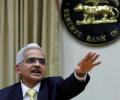
The MPC headed by RBI Governor Shaktikanta Das will announce the resolution of the meeting at around noon on Thursday.

Lenders of debt-ridden Reliance Capital have voted in favour of a resolution plan submitted by Hinduja Group firm IndusInd International Holdings Ltd (IIHL) which made the highest cash offer of Rs 9,661 crore in the second round of bidding. As much as 99 per cent votes were in favour of IIHL as lenders expected to recover cash upfront of Rs 9,661 crore from the Hinduja Group entity, sources said. Besides, sources said cash balance with Reliance Capital (RCAP) of over Rs 500 crore would also go to lenders. So, in all lenders are expected to receive about Rs 10,200 crore for distribution as against Rs 16,000 crore principal secured debt, resulting in 65 per cent recovery for the lenders, sources said.

Digital lending apps extend small amounts at exorbitant rates. Payment delays invite messages to customer or close family members, often with sensitive information such as Aadhaar and PAN Card scans.

The International Financial Services Centres Authority (IFSCA) has proposed key exemptions to the current listing framework and measures for setting up holding companies (holdcos) and special purpose acquisition companies (SPACs) to encourage domestic startups list at GIFT City, the country's only international financial services centre (IFSC). Under the current framework, to be eligible to list on IFSC exchanges, an issuing company should have operating revenue of at least $20 million in the preceding financial year and average pre-tax profits of at least $1 million during the preceding three financial years. An expert committee has noted these conditions have acted as hurdles to listing new-age companies, and they need a relook.
The CIC's directive came while deciding on a plea by Lucknow-based activist Nutan Thakur, who had based her RTI application on some media reports that RBI deputy governor Viral Acharya in a lecture in 2017 had said accounts of some loan defaulters have been sent to banks for resolution.
In the last three years, public sector banks have responded to the RBI's policy rates more strongly than private banks.

Although there is headroom for further monetary policy action, at this juncture it is important to keep our arsenal dry and use it judiciously: RBI's Das.
The Reserve Bank will hold a special meeting of its rate-setting committee on November 3 to prepare a report for the government on why it failed to keep retail inflation below the target of 6 per cent for three consecutive quarters since January. The six-member Monetary Policy Committee (MPC) headed by RBI Governor Shaktikanta Das will prepare the report on reasons for failure to meet the inflation target as well as the remedial measures the central bank is taking to bring down prices in the country. "Under the provisions of Section 45ZN of the Reserve Bank of India (RBI) Act 1934... an additional meeting of the MPC is being scheduled on November 3, 2022," RBI said in a statement on Thursday.

India's economic growth will be above 6 per cent in the current fiscal as the country has managed to strengthen its macroeconomic stability and performance even in a period of large global shocks, RBI Monetary Policy Committee (MPC) Member Ashima Goyal said on Monday. Goyal further said that a global slowdown reducing India's export growth, geopolitics fueling oil and food prices, and erratic weather are some of the continuing risks that the country faces. "India has managed to strengthen its macroeconomic stability and performance even in a period of large global shocks.

RBI had on February 12, 2018 issued a circular saying that lenders have to provide for resolution plan within 180 days in case of large account of Rs 2,000 crore and above.

IndusInd Bank was the top gainer in the Sensex pack, rallying over 4 per cent, followed by SBI, Bajaj Finance, Bharti Airtel, Axis Bank, Sun Pharma, HDFC and PowerGrid.

Bond markets, global as well as domestic, are likely headed towards hard times over the next three to six months, as higher vegetable prices, rising fuel costs, and improved wages may keep inflation hot, believe analysts, who expect the yields to hit 7.5 per cent in the near-term from the current 7.234 per cent. In this backdrop, they suggest investors can put in money in funds/instruments with residual maturity of 4 to 6 years, while longer-term investors can allocate cautiously to the longer end in the range beyond 7 years.

Kochhar's counsel argued that according to Section 35B (b) of the Banking Regulation Act, prior approval of the RBI is required to terminate the contract of a bank's chairman or managing director. But in this case, the RBI approval came after the termination letter was served.
Govt likely to get full control on policy rate.
Higher for longer' may be the narrative in the developed markets, but interest rates might not stay high for very long in India, with a section of the market expecting rate cuts to begin this year. The six-member Monetary Policy Committee of Reserve Bank of India (RBI) decided to keep interest rates unchanged at 6.5 per cent in the April review - after hiking the policy repo rate in six previous meetings. RBI Governor Shaktikanta Das emphasised that the pause was only for the April policy and that the central bank was ready to act if the situation demanded.

The economic growth is likely to moderate to 6.1 per cent, slowest in over seven quarters, from 6.6 per cent last year same period.
The Reserve Bank of India on Wednesday retained the economic growth projection for the current financial year at 10.5 per cent, while cautioning that the recent surge in COVID-19 infections has created uncertainty over the economic growth recovery. In its last policy review, the RBI had projected a GDP growth rate of 10.5 pc for FY'22. Taking various factors into consideration, it said, "the projection of real GDP growth for 2021-22 is retained at 10.5 per cent consisting of 26.2 per cent in Q1, 8.3 per cent in Q2, 5.4 per cent in Q3 and 6.2 per cent in Q4."

After Raghuram Rajan leaves, the world for the succeeding RBI governors will be distinctly different.

The RBI on Friday said the impact of coronavirus outbreak on the economy will depend on the intensity, spread and duration of the deadly virus even as the central bank refrained from projecting any numbers for growth and inflation amid the widespread uncertainty. While announcing the seventh bi-monthly monetary policy statement for 2019-20, RBI Governor Shaktikanta Das said that in view of the impact of coronavirus pandemic, the growth projections for 4.7 per cent for the fourth quarter of 2019-20 and 5 per cent for the full fiscal are "now at risk".
The International Financial Services Centre Authority (IFSCA) plans to operationalise the framework for direct listing of companies at International Financial Services Centre (IFSC) exchanges by the end of the year, said Chairperson K Rajaraman. He added that the amendments would be notified within three months. Further, the GIFT City regulator is also considering the launch of separate payments system regulations - similar to that of the real time gross settlement (RTGS) for banking within a few months.
After the screening, the shortlisted candidates will be vetted by an external committee, to be headed by former RBI governor, Bimal Jalan.
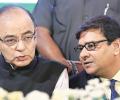
'For the RBI, for a central bank, reputational risk is the worst risk.' 'Credibility is the worst risk,'

Watal panel had suggested an independent payments regulator be set up.

Members of Parliament, state legislatures, and local governments not eligible to be members of PSB boards

Instead of a rate hike, or even a pause, there could be a window for the RBI for an interest rate cut

'Investment creates capacity and reduces inflation. Income, employment, and savings rise.'
 © 2026 Rediff.com - Advertise with us - Disclaimer - Privacy Policy - Sitemap - Feedback - About us - Terms of use - Grievances